In liquid chromatography, there are details that aren't visible… but they make a difference. One of the most common (and often underestimated) is the quality of the solvents and additives used in the mobile phase. Even if they appear correct at first glance, if they lack the necessary purity, they can completely compromise your analysis.
Why does purity matter so much?
Because pollutants—even in trace amounts—can cause:
-
- Unstable baselines
- Unwanted peaks (the famous ghost peaks )
- Low sensitivity in detection
- Damage to the spine or the system
- Unstable baselines
Each analytical method has its own requirements. In gradient applications, for example, the solvents must be of a specific grade to ensure reproducible results. And if you're working with mass spectrometry, using LC-MS solvents isn't optional: it's essential.
Water: Is it truly pure?
The water you use in your analyses must be more than just "clean." Ideally, it should be ultrapure and tailored to your needs (HPLC or LC-MS grade). Specialized purification systems ensure it is free of inorganic and organic contaminants, something a simple deionizer cannot guarantee. Keep in mind: often, water is the biggest source of noise in the system, and you may not even realize it.
Buffers and solutions: the latest and best filtered is always better 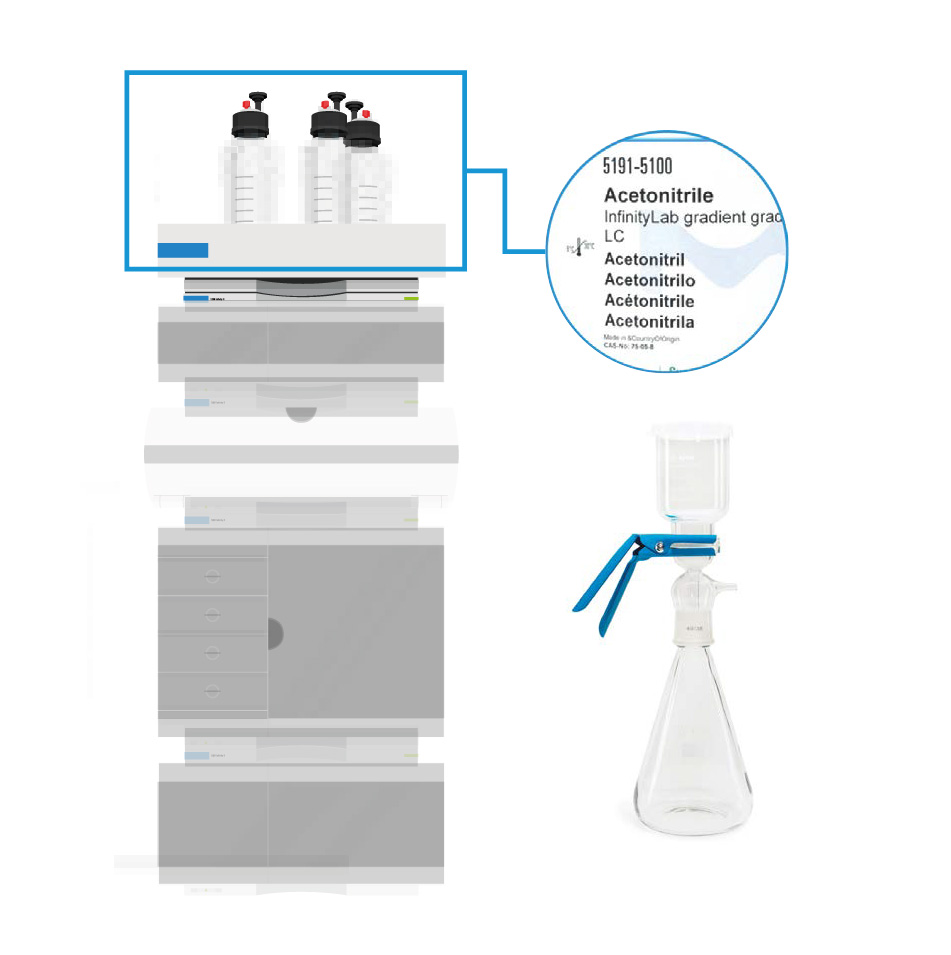
Aged or improperly stored buffers also pose a risk. In addition to degrading over time, they can serve as a breeding ground for microorganisms. To avoid this:
-
- Prepare the solutions just before the analysis.
- Always filter: 0.22 μm if using UHPLC, 0.45 μm for conventional HPLC.
- Adding a small percentage of organic solvent or preservatives such as sodium azide can make a difference.
- Prepare the solutions just before the analysis.
Human errors: as common as they are avoidable
Poorly sealed caps, bottles left open on the bench for hours, returning solvents to their original containers, or using expired reagents… These are small things, but their consequences can be significant. And the worst part: often you won't know where the problem is coming from until it's too late.
Take advantage of Carlo Erba's special promotion on solvents for liquid chromatography. Click here.