- The Heart of the Method: What is Thermogravimetry?
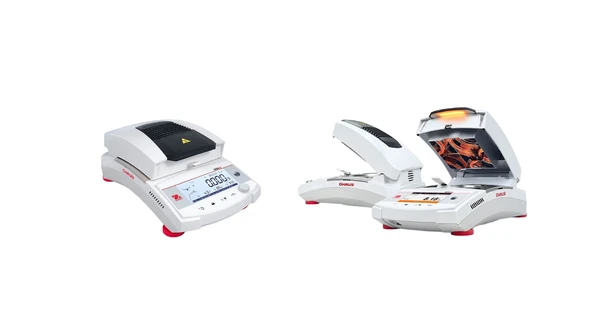
Thermogravimetry is an analytical technique that studies the change in mass of a sample as a function of temperature and time . While other methods (such as Karl Fischer titration) only react with water molecules, heat-based moisture analyzers use the Loss on Drying (LOD) principle.
The instrument weighs the sample while heating it, detecting the evaporation of:
- Free Water: present on the surface or in the pores.
- Bound Water: trapped in molecular structures.
- Residual Solvents: alcohols or organic waste derived from synthesis or washing processes.
- Aromatic Components: essential oils that can volatilize if the temperature is not controlled.
- The Evolution: From the Stove to the Halogen Analyzer
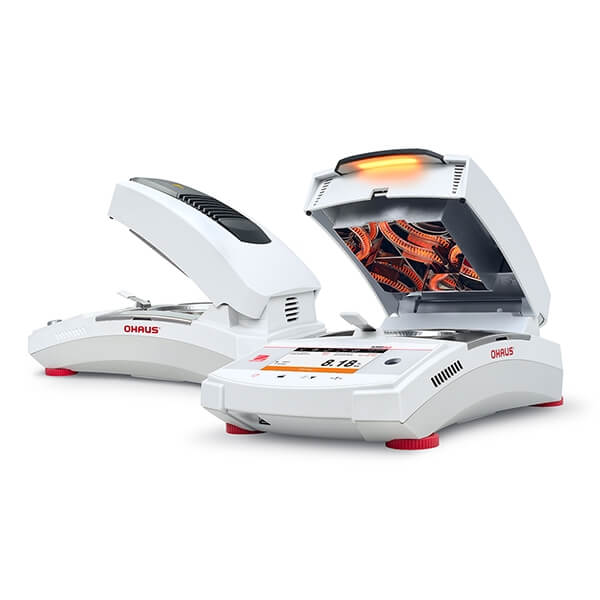
For decades, the gold standard has been the air-circulating oven , a slow process requiring multiple weighings, hours of waiting, and cooling in a desiccator. The modern moisture analyzer (or thermobalance) has revolutionized this process by integrating a precision balance and a heat source into a single automated system.
Advantages of switching to the Analyzer:
- Speed: it goes from several hours to 5-15 minutes .
- Accuracy: weighing occurs while the sample is in the instrument, eliminating the error caused by the reabsorption of ambient moisture during transport.
- Automation: the equipment identifies the "constant weight" and provides the result as a percentage on the screen.
- Applications and Markets
Where the determination of the LOD makes the difference:
- Food Sector: Online monitoring of LOD allows, for example, real-time adjustment of ovens to ensure a crisp texture. For flours and seeds, it is vital to prevent mold or toxins.
- Environmental: In sludge disposal, water is a significant cost. Monitoring the efficiency of dewatering presses drastically reduces the weight of waste sent for disposal.
- Pharmaceutical: Humidity affects the flowability of granules; if it is incorrect, tablets may be brittle or stick to punches. For Active Pharmaceutical Ingredients (APIs), it ensures that solvents are removed without degrading the molecule.
- Comparison of Ohaus MB Technologies and Range
Ohaus has designed the MB series to cover all needs, from production to research.
Analysis of Heating Technologies
|
Technology |
Mechanism |
Thermal Profile |
Speed |
Ideal for... |
|
Infrared (IR) |
Long wave |
Slow to stabilize |
Low |
Stable powders. |
|
Halogen |
Shortwave |
Fast and intense |
High |
Routine analysis. |
|
Carbon Fiber |
Modulated |
Uniform and stable |
Very high |
Complex matrices. |
The Ohaus MB Range
- MB23 : Robustness and simplicity for basic online controls.
- MB32 : versatility for quality control laboratories.
- MB62 : High accuracy (0.01%) for routine analysis.
- MB92 : advanced traceability and temperatures up to 200°C.
- MB120 : the top of the range with SmartGuide™ and user management for maximum traceability.
- Economic Analysis and ROI
The savings are not only in energy, but mainly affect time and quality.
Comparison of Operating Costs
|
Cost Item |
Traditional Stove |
Ohaus Analyzer |
Saving |
|
Operator Time |
15-20 min |
2-3 min |
~85% |
|
Waiting Time |
4 - 24 hours |
5 - 15 min |
~95% |
|
Energy |
High (2kW+ always ON) |
Low (400W test only) |
~70% |
Calculating the Return on Investment (ROI)
Assuming 5 analyses per day with a labor cost of €30/hour:
- Annual labor cost for stove: €11,250 .
- Annual labor cost for Analyzer: €1,875 .
- Annual savings: €9,375 .
The break-even point for an MB120 model is reached in approximately 5-6 months . If the savings in raw materials are taken into account (by avoiding waste production for hours while waiting for the stove's data), the ROI can drop to less than 90 days .
Conclusion
At Proquinorte, we'll advise you on the best equipment for your laboratory. For any questions or inquiries, please contact us.